The Future Is in His Hands – In 2018, barely one year after picking up a paintbrush for the first time, he was one of four candidates nominated for the prestigious Luxembourg International Art Prize. In 2019, he was asked to collaborate on a project with celebrity photographer, Steven Klein, and Travis Strote, Founder of Yogavated Athletics. That same year, he would also become the Main Stage featured artist at the Vogue sponsored POPSUGAR Play/Ground festival in New York City. In 2020, Vogue Italia hailed him as an “artist prodigy” in a feature article written about the creative and his work. Now, Ezra Blackwood is poised to be tapped for the 2022 Future Fields Commission, for which he will be asked to create a new work of art that explores the nature of perception.
“Anyone that has been around him long enough can attest to the fact that this is what he does. He is one of those people that can simply wake up one day, decide that he wants to try something new, and the next thing you know, almost in the blink of an eye, he’s out there winning awards for it and turning it into a source of income. That’s what he does. It’s the nature of who he is. The more determined he is, the more astonishing the results. He’s truly a force to be reckoned with when he sets his mind to something.” – Jason Farago, when asked for his thoughts on the incredible speed and grace of Blackwood’s style and skill evolution in 2021.
Happy Domain Day – The new year ushered in a new batch of artworks to the public domain, meaning they can now be freely reproduced for the first time since they were each made, in 1934.
Diversity in fashion is no longer simply a matter of race and ethnicity, size and age. It’s everything and anything.
It was breakfast time on the East Coast one morning in April, and Gucci designer Alessandro Michele was speaking to journalists via Zoom after debuting his new collection in a splashy film, “Gucci Aria,” on the Italian company’s website. The short movie, set in a make-believe nightclub, was a ready-to-wear mash-up of the brand’s history and its contemporary provocations, all set to a soundtrack that celebrated its influential position in popular culture. The songs “Gucci Gang,” “Green Gucci Suit” and “Gucci Flip Flops” serenaded the models as they walked.
Michele is both a contrarian and a prognosticator. Much of what he does goes against the grain and then becomes the standard. He didn’t characterize this collection, which marked the brand’s 100th anniversary, as one for fall or spring. He was simply showing 94 new ensembles on 94 models. And after the film ended, he settled into a chair in front of a carved mantelpiece set with blue porcelain to explain his eccentric thinking about clothes and casting.
For years, Michele has looked to the farthest extremes of human appearance for his models. “I analyzed all the strange faces, the freaks I placed on the catwalk, on the set,” Michele told us through an interpreter. “The strangeness sends a signal. It makes you turn somehow. And I really went in-depth there. I [dissected] all the forms of strange beauty.” In its marketing, Gucci embraced ugly ducklings, the jolie laide and the faces only a mother could love — decisions that influenced other brands to follow this path and to break down barriers.
But for this presentation, Michele hadmade an even more daring, evolved choice. “I tried to find what would define ordinary beauty,” he said. “The faces that you see in the film, the beautiful faces of many people you come across in the street, that beauty has its own life.” With so many miles and layers of technology separating us,something, anything, that felt real also felt profoundly valuable; the ordinary, in other words, is enough. Dressed in Gucci’s sparkles and marabou and velvet, regular people, too, have the capacity to deliver fashion that is transporting.
For generations, the modeling world was reserved for women and men with a certain élan and traditional Western appeal. Models were of a standard height: tall but not distractingly so. They were young and thin — and for much of the 20th century, they got progressively thinner until they were little more than stick figures with blood and sinew. They were born with long limbs, narrow hips, symmetrical facial features and a willingness to promenade in dizzyingly high heels. And mostly they were White.
But the ranks of models have been changing — slowly, incrementally — until, in a moment of relative quiet, with fashion’s carousel stilled by the pandemic, we can today look around and realize how different things are from a decade ago. Classic models are by far more racially diverse. Yet there are other, less sweeping changes that are no less significant. Models are alsomore varied by ethnicity, size, age and disability: Change is manifest in octogenarian author Joan Didion serving as the brand ambassador for Céline, model Halima Aden wearing a hijab and burkini in Sports Illustrated, writer Sinéad Burke making history as the first little person on the cover of British Vogue, and African American poet Amanda Gorman on the cover of the magazine’s American edition. In today’s fashion ecosystem, an amputee pinup pouts from the pages of a swimsuit calendar and a young woman with Down syndrome stars in a Gucci beauty campaign.
The deeper change, however, focuses on the nature of representation.Modeling hasn’t simply opened its doors to attractive members of groups that were once excluded or the so-called freaks that Michele adores. Increasingly, everyone is a model — or at least, everyone can be. We can be airbrushed influencers in our own Instagram stories, mini pitchmen on TikTok and street-cast character actors in advertisements for mass-market brands like Dove and Third Love or high-end labels such as Rick Owens and Balenciaga. Model agencies these days pride themselves on signing virtually anyone who simply wants to be a model rather than only those approved by conventional wisdom. Fashion models are no longer an embodiment of exclusivity. They are, instead, a reflection of the mundane and the gloriously imperfect.
The impetus for the fashion industry to rethink its exclusive ways is coming from outside and inside, from frustrated agitators wanting to upend the system and stakeholders who want to reinvigorate it. It’s coming after a year of racial unrest, a year in which so many of us have been forced to sit with our presumptions and stereotypes — and reconsider them. All of us should be counted among the beautiful ones, these change agents argue. All of us are worthy.
The photographs below are a product of a collaboration between photographer Jesse Dittmar and We Speak, an agency with a diverse catalogue of models. Interviews have been edited and condensed.
“I want to see not only the models being diverse; I want the whole team to be diverse.”
Kiara Marshall
“I walk an interesting line in the modeling industry where some parts of my look are very traditional.”
Maggie Berke
Two months ago, as designer Stella McCartney video-chatted with a group of journalists about her fall 2021 collection, I asked her if the past year had caused her to rethink how she defined beauty and whether it had broadened her understanding of diversity. Her vision of beauty hasn’t changed, she said, but she has recognized the importance of giving everyone an opportunity to be beautiful — that is, the room and encouragement to blossom in full. “This is just in my character, but out of a lot of bad, I think, has come a lot of good,” she said. “And it has exposed a lot of lessons to be learned.”
Now, to be clear, this is not an obituary for those gorgeous natural ectomorphs who continue to move among us, who torment hoi polloi with their slim figures, poreless skin and Dorian Gray agelessness. They continue to find favor on the covers of magazines and in commercial advertisements. They reign on the red carpet. They remain the standard against which everyone else is judged.
But the pushback against their so-called impossible beauty has grown more pronounced. And as boundaries dissolve, the definition of a fashion model has gotten fuzzy. Models have long been the most visible players in fashion; they are the public’s first point of contact with the industry’s mythology. Their role has always been to epitomize an ideal, setting the culture’s aesthetic preferences, values and infatuations. They were, traditionally, not meant to be a substitute for the average woman or man. They were hired because they were perceived as better than average.
And so, all of these changes prompt questions that may be both uncomfortable and impossible to answer but worth considering. What exactly is a model now? Is it merely anyone standing in front of a camera? And does standing in that space make you beautiful? Or does it simply make you visible?
Why, in the first place, does anyone want to be a model? There’s the money, of course. But basking in a Kendall Jenner lifestyle is about as likely as being drafted into the NBA. More readily attainable is a level of influence. It has been an opportunity to nudge the culture in a particular direction by making a visual argument about personhood and humanity. Models, by their very presence, influence who’s counted among the valued ones, the protected ones. Models indicate who among us is relevant.
Whom the industry welcomes into that spotlight — and when — tells us about politics, economics and social clout. During the 1990s, when Eastern Europe opened to the West, aspiring models poured into Paris and trickled into New York. The sheer abundance of these White, high cheek-boned, long-legged beauties signaled a diplomatic event far more vividly than the signing of any treaty. With the turn of the millennium, the rising consumer power of China triggered an increase in the numbers of models of Asian descent on the runway.
The 2000s also gave voice to diversity activist Bethann Hardison and a coterie of other agitators. Hardison, as well as businesswoman and veteran model Iman, looked at runways filled almost exclusively with White models and called on the industry to cast more Black women and men in shows and advertising campaigns. The demand for more Black models led to an influx of dark-skinned beauties with natural hair — an aesthetic that also reminded us of the long history of colorism while promoting a new authenticity politics.
More recently, the fraught, abstract arguments in Congress, in state legislatures and at dinner tables surrounding gender identity have been exhibited in the ranks of models. Nonbinary models have had celebrated starring roles on catwalks. At the same time, a single Instagram post for a Valentino campaign, featuring a male photographer’s nude self-portrait in all his feminine glory with a handbag, set off a firestorm over whether the picture was disrespectful of cis women.
“I want to change the perception of beauty for people with disabilities. But it’s not just about physical beauty.”
Bri Scalesse
“A lot of companies are kind of using the plus-size body as a way to target and market, and not in a genuine way.”
Ana Laura
Models are intellectual arguments about identity made real. They exist at inflection points in society. They’re a source of tension between what some desperately want and what others desperately fear. For years, Black models have been the human battleground over Black femininity — their visibility or invisibility a sign of the culture’s discomfort with allowing them to represent a privileged ideal. The industry continues to struggle with casual racism alongside more profound lapses — as non-White models serve as vehicles of hope and change.
“When I first got hired at Allure about five and a half years ago, someone wrote that it was like the luxury European automobile being replaced by the cheaper Asian model,” said Michelle Lee, editor in chief of Allure, during a Business of Fashion panel discussion on anti-Asian hate in March. “I think a lot about this word that everyone’s talking about now, which is ‘visibility.’ And so a lot of Asians are feeling like we’re just not seen. … Let me tell you, there are plenty of magazines out there who have not had one Asian on their cover in a long time. Or maybe they’ve had one since 2018, and Allure has had eight. And we’ve got two more coming in the near future.” She continued, “These decisions don’t happen by accident.”
The ranks of models are changing as the decision-makers and image-makers change. A new guard of editors (such as Lee, British Vogue’s Edward Enninful and Vanity Fair’s Radhika Jones), business owners (such as Alexandra Waldman, co-founder of the clothing brand Universal Standard), unconventional photographers and model agents recognize that people of all backgrounds have a hankering for edgy brands and status logos. It isn’t only the White, the young and the able-bodied who want to participate in fashion, in all its irrational, affirming glory.
“Modeling signals confidence,” Maddi Niebanck, a 26-year-old author and disability activist told me. “You have to be confident to the point where you can pose like that and put yourself out there for a photo.” Following a stroke, Niebanck wears an electrical-stabilizing brace on her leg. She’s not a professional model, yet she slipped into a tiny bikini and posed as Miss April for a calendar benefiting Models of Diversity, a charity promoting a more open and welcoming fashion industry.
“I can see a lot of progress. There’s representation all across the board.”
Justin Stewart
“It is positive because we’re seeing it everywhere. It is now mainstream.”
Ashley Carvalho
Ashley Carvalho, left, with twin and fellow model Kimberly.Kimberly, left, and Ashley.
“Fashion is interesting because it affords me the opportunity to try on different versions of myself,” Niebanck says. “It’s empowering, me wearing a bikini and wearing my Bioness unit on my leg and having a picture in that. That’s empowering to me — someone who doesn’t always necessarily feel confident.”
Disabled people have long been fighting their way into the fashion world. The late designer Alexander McQueen was inspired by Paralympian Aimee Mullins, who had both legs amputated as a child. She appeared on his runway in the late 1990s wearing prosthetics that looked like hand-wrought boots.
But McQueen’s spotlighting of Mullins didn’t open the fashion doors wide to other men and women who wear prosthetics, use wheelchairs or need accommodations in their daily lives. Mullins was a one-off, a McQueen obsession, a stunningly beautiful woman who was inspiring but not particularly relatable. In her wake, those with disabilities still couldn’t fully use fashion to present themselves to the world in the manner of their choosing. Only now is that beginning to change.
We Speak, a model agency founded in 2013 by Briauna Mariah, is part of that shift. Mariah aims to expand the ranks of working models to include a substantial number of people with disabilities or those who would otherwise fall outside the narrow confines of what has always been considered desirable. With a roster of about 130 New York-based models, We Speak is called on when casting directors are aiming to paint a picture that is inclusive as well as honest. “Relatability,” says Mariah, “is replacing the idea of unattainableness.”
For generations, models were presumed to be elusive rarities. They had to be painstakingly discovered — like porcini mushrooms in the wild. Model scouts worked the Rust Belt searching for a lithe swan amid the cornfed ducklings. They perused the fashion pages of regional newspapers, wandered nightclubs and turned over rocks searching for the makings of a star: someone who could fit the tiny sample garments that designers churned out for runway shows and photo shoots, someone who could conjure dreams, someone who was like no one else. A model was poisonous perfection as viewed through a narrow lens.
Initial attempts at diversification didn’t really break this dynamic. Waldman points to the case of plus-size model Ashley Graham. “I never felt like — and this is in no way disparaging to anyone,” Waldman told me, as she paused and sighed and weighed her words with diplomatic care. “She has an incredibly important part to play. And she’s a great ambassador. A smart woman. Delightful. But when Ashley Graham was picked up by the fashion industry and put on a pedestal and the industry started patting itself on the back for being inclusive — uh, Ashley Graham is as much of an outlier as Kate Moss. She is an extraordinary beauty in the sense that the fashion industry is used to.”
“She just happens to be, you know, heavier than they’ve seen before. But she is not representative of a bigger woman,” Waldman continued. “And so for her to be sort of pointed to by the fashion industry as an example of body diversity to me was really odd, because she’s as rare as a diamond, you know. She’s as rare as any supermodel.”
Today, however, there are more plus-size stars in addition to Graham, increasing the diversity in this tiny corner of the fashion industry: Candice Huffine and Marquita Pring, for instance, as well as Precious Lee, who appeared on the April cover of British Vogue. These women and others participate in the marketing strategies of brands as quirky as Eckhaus Latta and as Cinderella-centered as Christian Siriano. “I don’t even like to call it inclusivity because it makes me think of exclusivity and the fact that somebody is a gatekeeper and kind of allows you to come in,” Waldman said. “I think of it more as equality — equal access to allow people to present themselves the way they want to the world, and be admired.”
The expansion of modeling, it turns out, has gonemuch further than the welcoming of historically marginalized groups into an exclusive club. It’s the entire concept of exclusivity that has now been called into question.
“I always want to do a good job because it just feels like I really need us to be seen at this point.”
Oskar Sinclair
“I now know that compromising who I am for the comfort of others leads to everyone losing.”
Sophie Kietzmann
The definition of a model has changed not only because of cultural shifts but also because of technology. In the recent past, having a portrait taken was an event — particularly in marginalized communities. The occasion might be class picture day, a quinceañera or the senior prom — that rite of passage marking a first opportunity to document a grown-up expression of glamour and individuality.
Or maybe an entire family, decked out in color-coordinated Christmas ensembles, would bundle themselves off to the local portraiture studio — one tucked just beyond the washing machines and snowblowers in an old-fashioned Sears, Roebuck and Co. department store. Perhaps a striving couple in matching fur coats would make an appointment to memorialize having reached a higher rung of status. These people weren’t famous. They weren’t paid professionals. Still, they were creating a visual narrative about style, swagger and identity. In essence, they were modeling.
When Eastman Kodak introduced the inexpensive Brownie camera at the dawn of the 20th century, the masses could easily photograph each other. And certainly, the arrival of Polaroid cameras, disposable ones and iPhones made portraiture a less precious act. But it was only with the introduction of social media that the full nature of personal photography transformed.
The culture exploded “in the early 21st century with platforms like Instagram and Twitter and Tumblr and Myspace and all of those places where you were asked to put pictures of yourself online,” says Antwaun Sargent, author of “The New Black Vanguard,” a survey of contemporary photographers of color. “I think that changed some of our expectations around who gets to be seen and how those representations are appreciated in relationship to desire, in relationship to beauty, in relationship to identity.”
A generation of young adults has grown up with an innate belief that they could be the star of a public narrative of their own creation. While they still appreciate a supermodel, they no longer need such a person to convince them of the glories of a designer’s most recent fashion collection. Their friends and acquaintances — and their own fish-mouth selfies — were persuasive enough, especially when those images could be manipulated as convincingly as any airbrushed Vogue cover.
Story continues below advertisement
null
“We’ve gone through this revolution around identity … and trying to rectify some of the erasure that fashion has long engaged in,” Sargent says. “I think that definition of ‘the everyday,’ of people who are ‘normal’ — those notions have settled into the fashion world.” He adds, “People are modeling who they are.”
The definition of a model is also being altered by a new generation of photographers who are more acutely aware of the urgencies of autonomy and personal narrative. If anyone can be in front of a camera, what makes someone stand out and draw others in is their visual story, their realness. For generations, models were not a representation of human beings, but were instead decorative objects. It’s why we tend to refer to women with perceived flaws as “real.”
The truth is that most photographers have always been drawn to models who were ostensibly more than a pretty face, who were funny or good conversationalists or had interesting personal histories. The difference is that now those backstories, or at least some aspect of them, are evident. Their disability, their place in the middle of the gender spectrum, their racial marginalization — all the ways in which they might be different from the old standard are front and center and celebrated.
“There’s more and more collaboration between subject and photographer,” says Sargent, who was appointed a director and curator at Gagosian, a global network of art galleries, in January. In the past, a model “stood there and you moved the way the photographer wanted you to move and that was the image, right? There was no, sort of, sharing of authorship, right? And I think that today, because people have such a strong sense of themselves, because of the ways in which they’re constantly sort of building a brand-new identity that has to work online, that, like, now, when you walk into a photo shoot, you’re bringing all of that knowledge with you.”
The photographers “always speak in terms of collaboration,” Sargent continues. “And they always speak in terms of constructing an image that also has something to do with the subject or the people that are in that image.” The models are just real people standing in front of a camera telling their story. And that may be enough.
Everything about modeling today is a political act. Sometimes it’s a laborious protest of rigid tradition or a visual treatise on the burdens of popular expectations. But often, it’s simply a joyful declaration that we all should be able to participate in the fizzy aspects of life.
Sargent, for one, is fretful about a backlash. After all, fashion’s pendulum never stops swinging. Fashion has a history of becoming enamored with a particular personality or cultural moment. And then after a few beats, it moves along to the next article of enchantment.
But at least for now, fashion has turned some of its attention away from high-gloss perfection and toward the infinite variations of the quotidian. When Waldman tries to describe her appreciation for the changing fashion dynamic, she points to the difference between being given a bouquet of flowers from a fancy florist — with each blossom having been carefully edited for flaws — and receiving a nosegay of wildflowers. “Both of them can take your breath away. Both of them can be extraordinarily beautiful,” Waldman says. “It doesn’t have to be one or the other. I think that what is available to us to regard as beautiful, and worthy of being coveted, or worthy of looking up to, is much, much broader than we’ve been led to believe all of these years.”
The impossible dreams of fashion are now being peddled to us by us. Average, everyday people are selling us toiletries and underwear, designer handbags and wondrously fanciful frocks. They are part of the system that frustrates, demoralizes, bewilders and on rare and marvelous occasions, makes us gasp with delight. And if we have any complaints about the beautiful lies or the unvarnished truths, we will have to look among ourselves when seeking someone to blame.
The Future Is in His Hands – In 2018, barely one year after picking up a paintbrush for the first time, he was one of four candidates for the Luxembourg International Art Prize. In 2019, he was asked to collaborate on a project with celebrity photographer, Steven Klein, and Travis Strote, Founder of Yogavated Athletics. That same year, he would also become the MainStage featured artist at the Vogue sponsored POPSUGAR Play/Ground festival in New York City. In 2020, Vogue Italia hailed him as an “artist prodigy” in a feature article written about the creative and his work. Now, Ezra Blackwood is poised to be tapped for the 2022 Future Fields Commission, for which he will be asked to create a new work of art that explores the nature of perception.
“Anyone that has been around him long enough can attest to the fact that this is what he does. He one of very few people in the world that can simply wake up one day, decide that he wants to try something new, and the next thing you know, almost in the blink of an eye, he’s out there winning awards for it and turning it into a source of income. That’s what he does. It’s the nature of who he is. The more determined he is, the more astonishing the results. He’s truly a force to be reckoned with when he sets his mind to something.” -Jason Farago, when asked for his thoughts on the incredible speed and grace of Blackwood’s style and skill evolution in 2021.
Happy Domain Day – The new year ushered in a new batch of artworks to the public domain, meaning they can now be freely reproduced for the first time since they were each made, in 1934.
At a time when sustainability is gradually becoming part of our daily practices and language, fashion is perhaps the one among all the industries that most needs a radical change of direction towards an environment-friendly solution that, however, also aims to safeguard the well-being of the body and mind. This is how sustainability and the world of sports come into contact, promoting a message that expands the concept of sustainable practices also to physical and mental well-being.
In this scenario, according to Vogue Italia, there are three leading international brands.
Among these, Norba promotes products created by women for women, functional for both sports and daily practices. The brand was born in 2018 in Ukraine, from the creative minds of two sisters Olha and Helen Norba. The products are made of econyl, (recycled nylon from waste and plastic collected from the oceans) and range from leggings to tops, ideal for practicing pilates or yoga, but also for more intense activities.
The two creatives told Vogue that: “We created Norba about two years ago wanting to create a perfect and minimal type of clothing for training. The idea of athleisure has been around for some time, but we noticed that it was still impossible to find sportswear that perfectly suited the women’s wardrobe. Developing a brand responsibly in this particular historical moment is not optional, it is the only option we have and it is exactly what everyone in the fashion world should do now. […] “
Inhala Soulwear was created by three Peruvian yogins. Promoting a lifestyle dedicated to the well-being of mind and body is the mission of the brand. The term Inhala, deriving from the English “inhale” (to breathe) reminds us that breathing is at the basis of the connection between mind and body, and therefore perfectly in line with the message they want to convey. Inhala also promotes “slow-fashion” production, creating small capsule collections in certified laboratories and in collaboration with international designers and artists.
The products are colorful and simple and created with organic materials including packaging, in which there is also a basil seed that the customer can plant.
The Minu is the brand born in 2019 and created by Alessandra Albertini. The brand’s intentions are clear and resonate with the slogan: activewear that cares. In addition to sustainability, the fundamental concepts that are at the core of the brand are femininity, performance and style. After an experience in India in which she approached the world of yoga, Alessandra reflected on the combination of comfort and femininity in sports practices.
The main material is econyl here too, combined with imaginative and colorful prints that manage to make the workout a little less heavy and more creative and livelier. Leggings and tops adapt to any type of shape and sporting need. The peculiarity of the brand is that each top bears the name of a famous woman, sporty and not; the top Steffi Graf is in fact dedicated to the famous tennis player who won the Grand Slam, the top Hypatia instead, is dedicated to the brilliant Greek astronomer and philosopher. “[…] The Minu is a brand that focuses on inner well-being as well as physical well-being, because playing sports is good for the mind even before the body. Alessandra told Vogue Italia “I have never been an ad-hoc sportswoman but through the practice of yoga I understood that being sporty could have many facets.”
Vogue Italia Reduced Its Carbon Footprint by Hiring Artists to Illustrate Its January Issue Instead of Staging Photo Shoots
Vanessa Beecroft and David Salle are among the artists contributing to the issue.
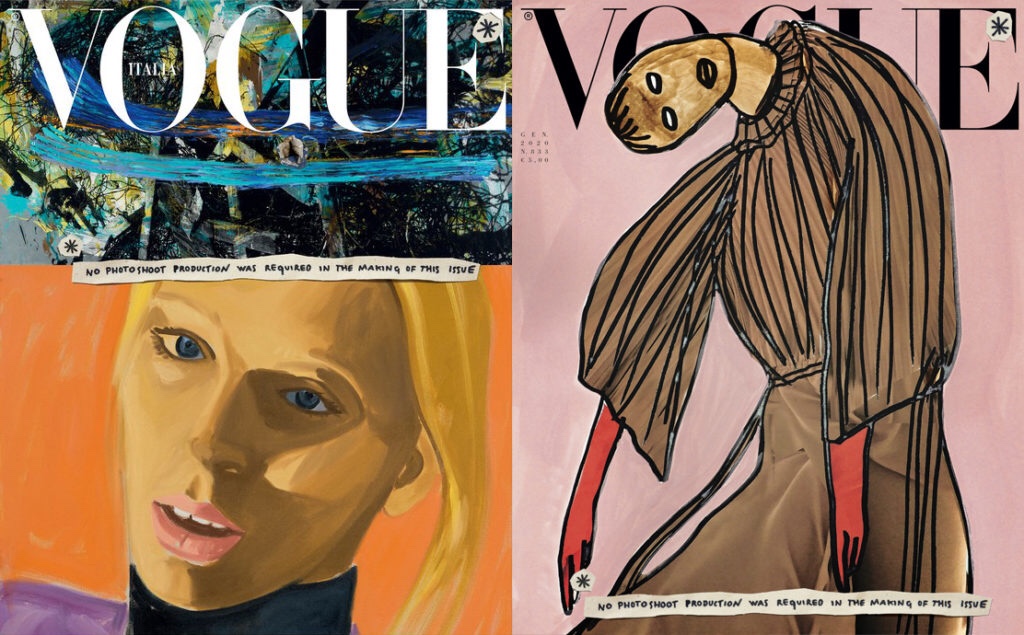
Two covers of Vogue Italia’s January 2020 issue. Left cover by David Salle. Right cover by Vanessa Beecroft. Courtesy of Vogue Italia.
In an effort to reduce its carbon footprint, Vogue Italia won’t publish any glossy photo shoots in its January issue. Instead, it is commissioning artists to illustrate its pages.
The environmental toll that the production of Vogue photo shoots takes is substantial, says Emanuele Farneti, the magazine’s editor in chief, in a note to readers.
“One hundred and fifty people involved. About twenty flights and a dozen or so train journeys. Forty cars on standby. Sixty international deliveries. Lights switched on for at least ten hours nonstop, partly powered by gasoline-fueled generators. Food waste from the catering services. Plastic to wrap the garments. Electricity to recharge phones, cameras,” Farneti writes.
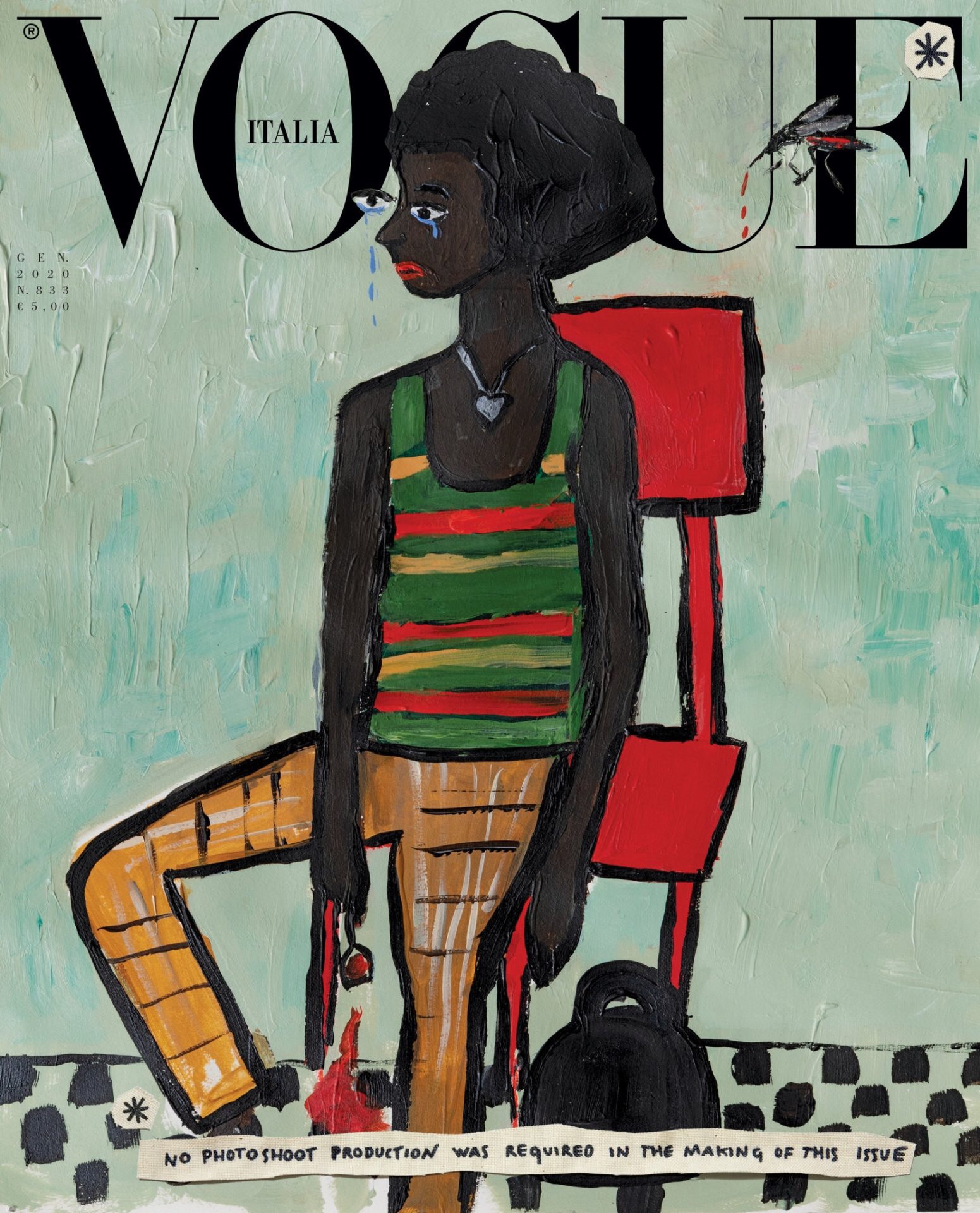
The move marks the first time that any of Vogue‘s international magazines have published an issue without a photographic cover. Among the artists tapped to create one of the issue’s eight custom covers are Vanessa Beecroft, David Salle, Cassi Namoda, and Milo Manara. Though mixed in their aesthetic styles, each cover depicts a model wearing Gucci clothing and bears the phrase, “No photoshoot production was required in the making of this issue.”
One of the covers for Vogue Italia‘s January 2020 issue, designed by Cassi Namoda. Courtesy of Vogue Italia.
“Change is difficult, but how can we ask others to change if we are not prepared to call ourselves into question?” Farneti writes. “Accordingly, this month we wanted to launch a message: that creativity—which has been a cornerstone of Vogue for nearly 130 years—can, and must, prompt us to explore different paths.”
The money saved on the January issue will be donated to the Fondazione Querini Stampalia, a cultural center in Venice damaged by last November’s flood.





 aesthetica